
Part Types
19-Inch Rack and Equipment Cabinet Fabrication
Racks and cabinets look like simple sheet metal until you build one. The rail spacing has to be right or nothing mounts. The frame has to stay square under load. The doors have to close after the whole thing has been welded, coated, and shipped. Getting all three at once is the job.
We fabricate racks, cabinets, and equipment frames in aluminum, cold rolled steel, and stainless, from single units through production releases, and we build them at our plant in Miami Gardens rather than assembling imported panels.
What We Build
Racks, Cabinets, and Frames
19-Inch Equipment Racks
Standard EIA-310 rail spacing with punched or tapped mounting, open frame or enclosed, in any height you specify rather than the standard U counts an off the shelf supplier offers.
Server and Network Cabinets
Enclosed cabinets with perforated or solid doors, cable management, and airflow provisions sized to the actual heat load rather than a catalog assumption.
Electrical and Control Enclosures
Wall mount and freestanding cabinets with gasketing, back panels, mounting rails, and cutouts for the components you are actually installing.
Outdoor Rated Cabinets
Weather resistant construction for equipment going outside in a coastal climate. Sealed seams, drip edges, corrosion resistant hardware, and finishes chosen for salt exposure.
Consoles and Operator Cabinetry
Desks, consoles, and workstation cabinetry for control rooms, transit facilities, and monitoring environments.
Equipment Frames and Skids
Structural frames, subframes, and mounting skids that carry load and locate components accurately.
On Our Floor
Racks We Have Built
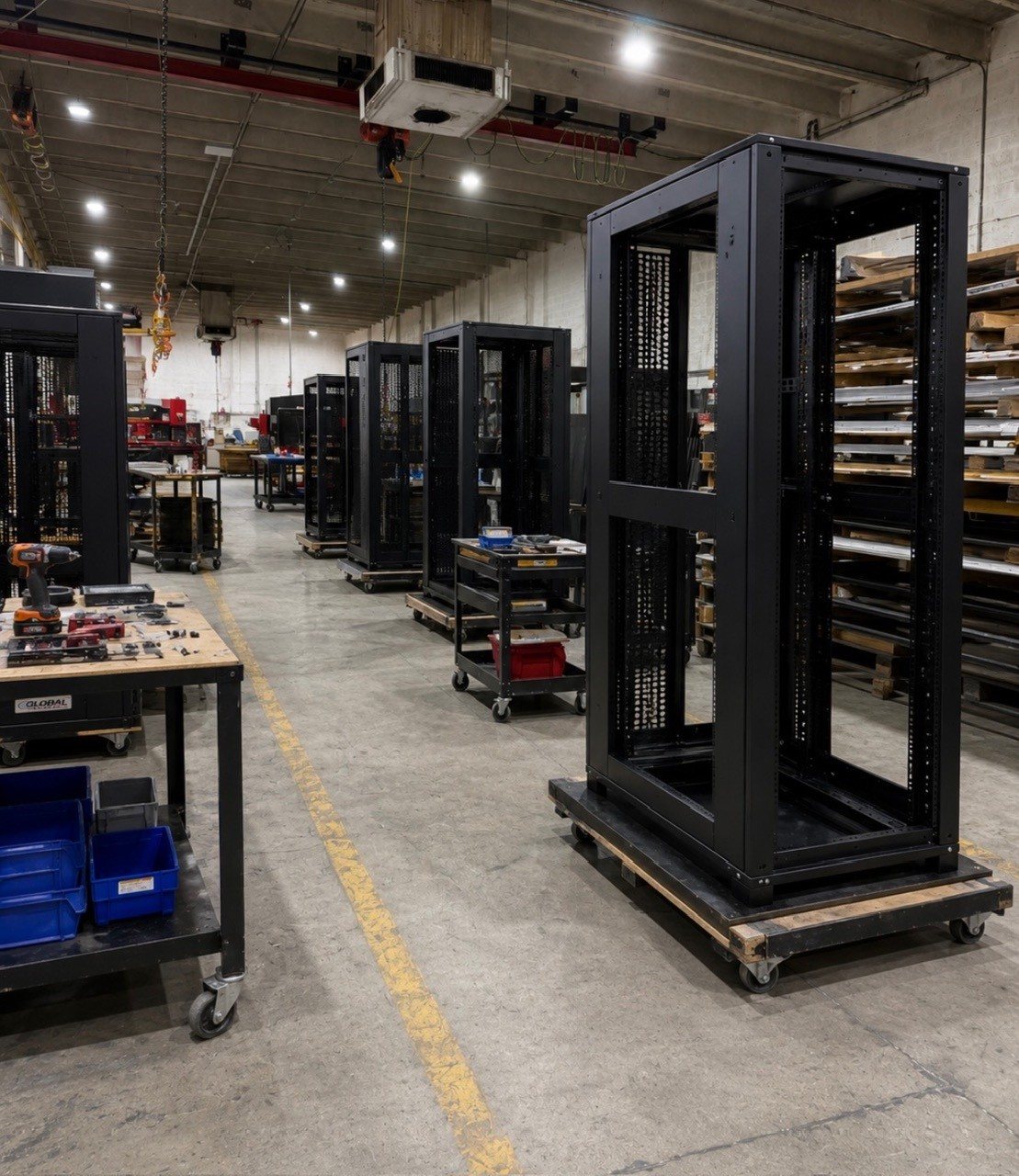
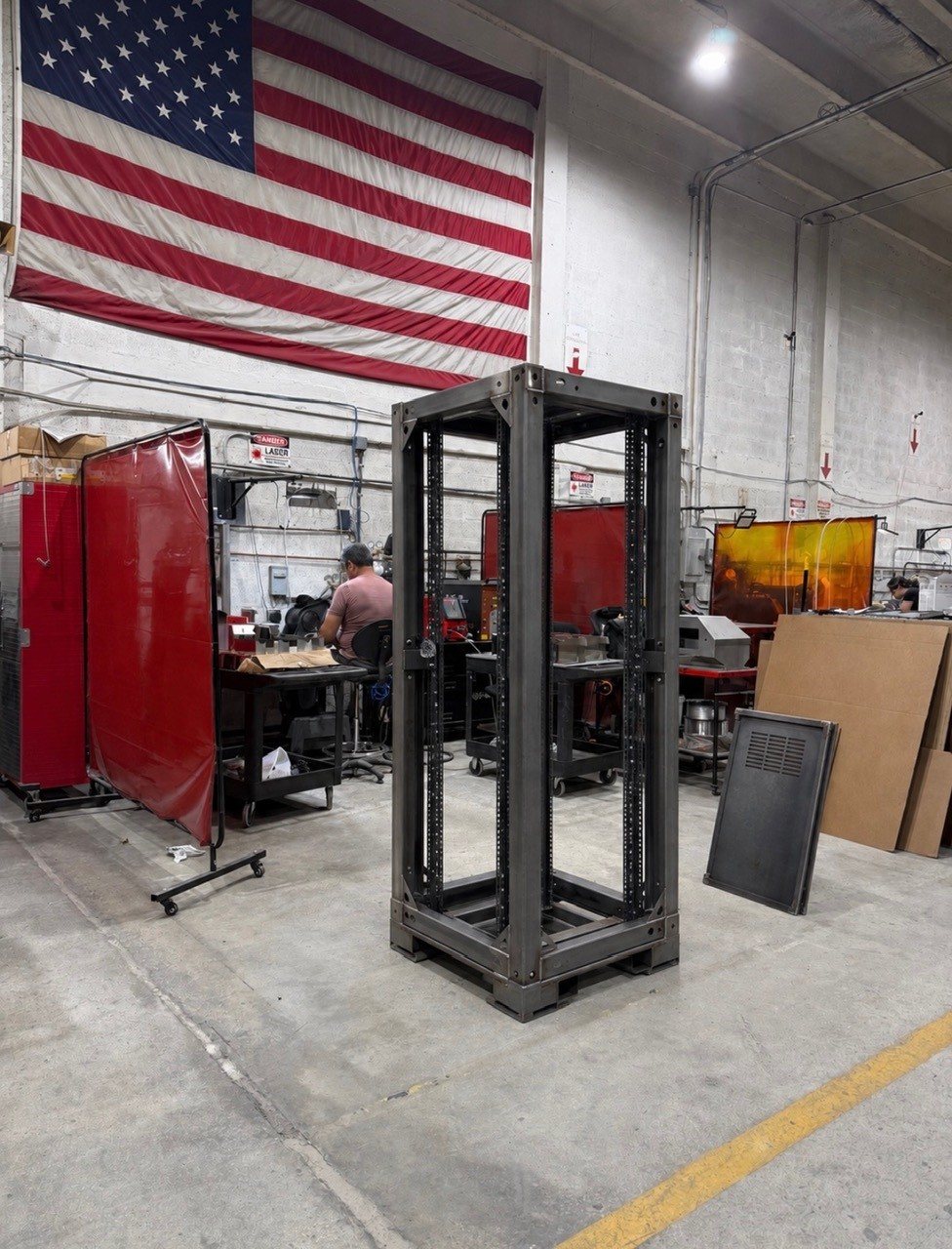
Welded frames, drilled and tapped rail sets, and finished cabinets staged for assembly. Everything here was cut, formed, welded, and built in Miami Gardens.
Engineering
What Separates a Good Rack From a Bad One
Squareness Under Load
A frame that measures square empty can rack out once it is loaded and rolled across a floor. Gussets, corner design, and weld sequence are what keep it square, and weld sequence is decided on our floor, not on the print.
Weld Distortion
Long thin frame members move when you weld them. Our nine IPG fiber laser welders put far less heat into the part than conventional MIG, which means less pull, less straightening, and doors that still align after coating. See fiber laser welding.
Door and Panel Fit
Door gaps are the first thing anyone notices. They depend on frame accuracy, hinge selection, and accounting for coating thickness in the gap. That last one gets missed constantly.
Rail Accuracy
EIA-310 hole patterns accumulate error over 40-plus positions. Punching the pattern in one operation from one datum avoids the stack up you get from indexing.
Thermal and Airflow
Perforation pattern, open area, and door design determine whether the cabinet moves air. Worth settling before the panels are cut.
Grounding
Coated panels do not conduct. Bonding paths between frame, doors, and rails need masked pads or thread forming hardware designed in from the start.
Build Options
How Far We Take It
Some customers buy bare metal and do their own assembly. Others want the cabinet to show up ready to populate. We do both, and the decision is usually about where your labor is cheaper than ours.
Flat Blanks and Formed Parts
Cut, formed, deburred, and shipped flat or nested. You weld and assemble. Lowest freight cost per unit because flat parts stack.
Welded and Finished Frames
Frame welded, ground where it shows, and finished. See powder coating and finishing for coating options and masking requirements.
Hardware Installed
PEM studs, standoffs, nutserts, cage nut strips, and captive fasteners installed to your print before the parts leave. Pull-out and torque checked against spec.
Mechanical Assembly
Doors hung, hinges and latches set, gaskets applied, fan trays and filter frames mounted, casters or leveling feet installed, panels fit and labeled.
Kitted and Serialized
Parts bagged, tagged, and kitted by assembly so your line pulls one box per unit. Serial plates and asset labels applied if you supply the numbering scheme.
Drop Shipped
We ship direct to your integrator or your end customer under your packing slip. Crated for freight when the cabinet is tall enough that a pallet alone will not survive the trip.
RFQ Package
What to Send Us
Rack and cabinet quotes go faster when the RFQ answers the questions we would otherwise have to ask. Send STEP files for the parts plus a dimensioned PDF with your critical dimensions called out. If the cabinet is an assembly, send the assembly model too so we can check fit before we cut anything.
Tell us the load: what goes in it, how much it weighs, and whether it gets moved loaded. A cabinet holding 200 pounds of network gear and a cabinet holding 2,000 pounds of UPS batteries are not the same weldment even if they look identical on the outside. Tell us the environment too, because outdoor and washdown change material and sealing.
Call out your rail standard and hole pattern explicitly rather than leaving it implied. EIA-310 square hole, tapped 10-32, tapped 12-24, and metric are all common and they are not interchangeable. Same with rack unit count and mounting depth.
Volume and schedule matter more here than on most parts because fixturing cost is real. See low and medium volume production for how run size moves piece price, and fabrication tolerances for what we hold on formed and welded features.
Common Questions
Frequently Asked Questions
What rack sizes and U heights can you build?
Any U height. The 19-inch EIA-310 mounting width is the standard we build to most often, and rail spacing, hole pattern and depth are all built to your print. We also build 23-inch and non-standard widths when the equipment demands it, along with wall-mount, open-frame and fully enclosed cabinets.
Do you punch the rack rails yourself?
Yes. EIA-310 square hole, round hole and tapped rail patterns are punched or laser cut in house on our Amada equipment. Hole position is what makes or breaks a rack, so it is cut on the same machine that cuts the panel rather than sent out where the datum can shift.
What materials do you use for rack cabinets?
Cold rolled steel for most enclosures, aluminum where weight matters, stainless where the environment is washdown, marine or corrosive. Gauge depends on load. If you tell us what the rack has to carry and where it lives, we will tell you what we would build it out of and why.
Can you assemble the cabinet, not just fabricate the panels?
Yes. Hardware insertion, PEM standoffs, hinges, latches, gaskets, fans, filters, cable management, slide rails and painted and marked panels all get installed here. Most customers take a complete cabinet off our dock rather than a box of parts. If you want us to install customer-supplied components, we do that too.
Do you build to our drawing or can you help design it?
We build to print, and every print gets a free manufacturability review before we cut. If you know what the rack has to hold but not how it should be built, send the equipment list, the load, the airflow requirement and the environment. Forty-seven years of building enclosures means we have already solved most of it once.
Can you do venting, EMI shielding and grounding?
Perforated panels, louvers, fan cutouts and filter mounts are routine. If the cabinet needs a conductive path to ground, identify the masked areas on the drawing so powder coat does not break continuity, and call out gasket channels where you need them. Those are cheap details to design in and expensive ones to add after the fact.
Is there a minimum order for rack cabinets?
No. We build one-off cabinets for prototypes and integration projects, and we build repeat production runs on blanket orders with scheduled releases. Per-unit cost drops with quantity because setup and programming spread out, but there is no floor to place an order.
Next Step
Send Us a Print
Email your drawing package to sales@mjmmfg.com or call (305) 620-2020. Send STEP or DXF files with a dimensioned PDF and we will come back with pricing, lead time, and any manufacturability notes worth flagging before you release the design.
MJM Manufacturing, Inc. — 5205 NW 161 Street, Miami Gardens, FL 33014. CAGE Code 0YLX1.