News & Updates from MJM Manufacturing
MJM News
Equipment investments, certifications, milestones, and practical guides for engineers and buyers — from Miami Gardens’ premier precision sheet metal fabrication facility.
Materials & Design · July 2026
5052 vs. 6061 Aluminum for Sheet Metal Fabrication: Which Alloy Should You Choose?
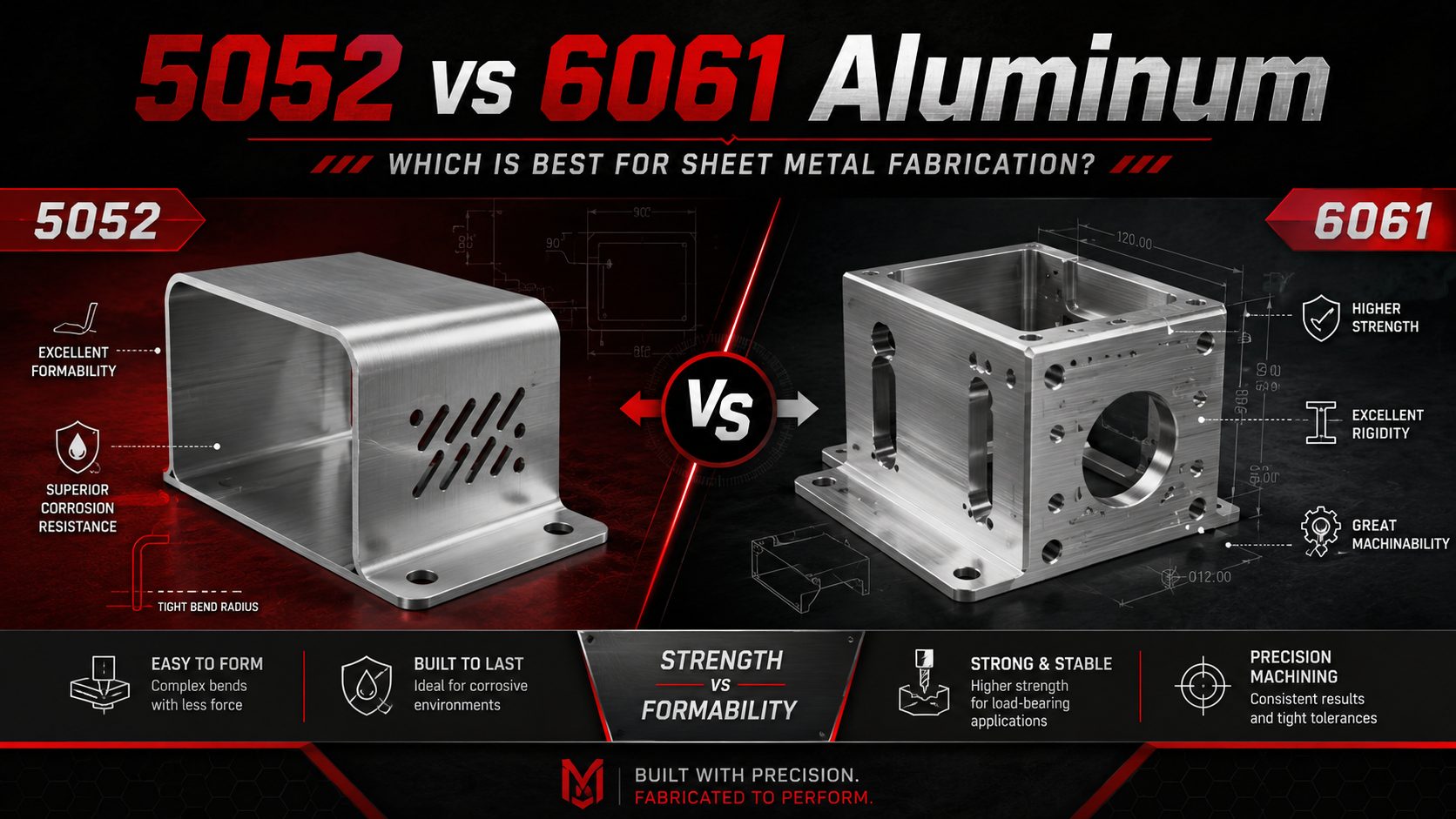
5052 and 6061 aluminum both cut and fabricate cleanly at MJM — but they behave very differently at the brake, under load, and after finishing.
It’s one of the most common questions we get before a quote: should this part be 5052 or 6061 aluminum? Both are workhorses of sheet metal fabrication, both are widely available, and both will make a good part — but they behave very differently at the brake, under load, and after finishing. Choosing the right one up front saves cracked bends, failed welds, and re-quotes later.
Here’s the short version, then the detail behind it.
The Quick Answer
Choose 5052-H32 for parts that bend — enclosures, panels, cabinets, chassis, and marine components. It forms tighter, resists corrosion better, and takes a clean finish.
Choose 6061-T6 for parts that carry load — structural frames, brackets, and components with machined features, where strength and rigidity matter more than tight bends.
Side-by-Side Comparison
| Property | 5052-H32 | 6061-T6 |
|---|---|---|
| Strength | Moderate | High |
| Bendability | Excellent — tight radii | Limited — needs larger radius |
| Weldability | Excellent | Good (loses temper at weld) |
| Corrosion Resistance | Excellent — marine grade | Good |
| Machinability | Fair | Excellent |
| Anodizing / Finish | Very good | Good |
| Typical Use | Bent enclosures, panels, marine | Frames, structural, machined parts |
Strength & Structural Performance
6061-T6 is the stronger alloy. Its T6 temper gives it significantly higher yield and tensile strength than 5052-H32, which is why it’s the default for structural frames, load-bearing brackets, and any part that needs to stay rigid under stress. 5052 is no lightweight — it’s plenty strong for enclosures and panels — but if the part’s job is to carry load without flexing, 6061 is the answer.
Bendability & Minimum Bend Radius
This is where the two alloys diverge the most, and it’s the decision that trips up the most drawings. 5052-H32 forms beautifully — it tolerates tight bend radii without cracking, which makes it ideal for enclosures, boxes, and panels with multiple close bends. 6061-T6, in its hardened temper, is far less forgiving: bend it too tight and the outside radius will crack. As a rule, 6061-T6 needs a noticeably larger inside bend radius than 5052 of the same thickness.
If your part has tight bends and has to be 6061 for strength reasons, there are options — forming in a softer temper and heat-treating after, or opening up the radius. Our design-for-manufacturability review flags this before production, and our online tools can show you the difference in achievable radius between the two alloys.
Welding Characteristics
Both alloys weld, but 5052 is the easier and more predictable of the two. 6061 welds well too, with the important caveat that the heat of welding locally softens the T6 temper in and around the weld — the joint area loses some of the strength that made you choose 6061 in the first place. For welded assemblies where strength at the joint matters, that has to be designed around. For enclosures and panels that are welded and then finished, 5052 usually gives fewer headaches.
Corrosion & Marine Environments
5052 is the marine-grade choice. Its magnesium content gives it excellent resistance to saltwater and harsh environments, which is why it’s the standard for boat components, outdoor enclosures, and anything exposed to weather or spray. 6061 has good corrosion resistance for general use, but in a genuine marine or coastal application, 5052 is the safer specification.
Machining & Laser Cutting
If your part has machined features — tapped holes, pockets, precise faces — 6061 is the better material. It machines cleanly and holds tight tolerances, while 5052 is gummier and less suited to heavy machining. Both cut cleanly on our Amada fiber lasers with nitrogen assist for oxide-free edges, so laser cutting isn’t usually the deciding factor — it’s what happens after the cut that drives the alloy choice.
Powder Coating & Anodizing
Both alloys powder coat and anodize well. 5052 tends to give a cleaner, more uniform anodized appearance, which matters on cosmetic parts. 6061 anodizes fine but can show more variation. For a visible finished panel where appearance is critical, 5052 has a slight edge; for a structural part that will be coated, 6061 is perfectly good.
Cost
Material cost between the two is usually close, and it’s rarely the deciding factor — the real cost difference shows up in fabrication. Specifying 6061 for a part with tight bends can drive up cost through cracked parts, larger radii that change the design, or added steps. Specifying 5052 for a part that needed 6061’s strength can mean a part that flexes in service. The cheapest part is the one built from the right alloy for how it’s actually used.
How to Choose for Your Part
Ask what the part has to do. If it bends, gets welded into an enclosure, lives outdoors, or needs a clean finish — 5052-H32. If it carries load, needs machined features, or has to stay rigid — 6061-T6. When a part needs both tight bends and high strength, that’s a real design conversation worth having before the drawing is released, and it’s exactly what our team reviews on every quote.
Not Sure Which Alloy Your Part Needs?
Send us your drawings and our team will review the part — strength, bends, welds, finish, and cost — and recommend the right alloy before you commit the job. Email sales@mjmmfg.com or call (305) 620-2020.
5052 vs. 6061 — FAQ
Which is stronger, 5052 or 6061 aluminum?
6061-T6 is stronger, with higher yield and tensile strength. It’s the better choice for structural and load-bearing parts. 5052-H32 is moderately strong and better suited to bent enclosures and panels.
Can 6061 aluminum be bent?
Yes, but 6061-T6 requires a larger inside bend radius than 5052 and can crack if bent too tight. For parts with tight or multiple bends, 5052-H32 is usually the better choice. 6061 can be formed in a softer temper and heat-treated afterward when strength and tight bends are both required.
Which aluminum is best for enclosures?
5052-H32 is the go-to for sheet metal enclosures, cabinets, and panels because it forms tight bends cleanly, resists corrosion, and finishes well.
Which aluminum is better for marine use?
5052 is marine grade. Its magnesium content gives excellent saltwater corrosion resistance, making it the standard for boat components and outdoor enclosures.
Which is easier to weld?
Both weld well, but 5052 is more predictable. 6061 welds fine but loses some of its T6 strength in the heat-affected zone around the weld, which must be accounted for in load-bearing joints.
Ready to Work With MJM?
47 years of precision. 80+ employees. 44,000 sq ft. Get a quote within 24–48 hours at sales@mjmmfg.com.
MJM Manufacturing, Inc. | AS9100 Certified | ISO 9001 Certified | ITAR Registered | DBE Certified | AWS D17.1 Aerospace Welding | 5205 NW 161 Street, Miami Gardens, FL 33014 | (305) 620-2020