News & Updates from MJM Manufacturing
MJM News
Equipment investments, certifications, milestones, and updates from Miami’s premier precision sheet metal fabrication facility.
Finishing & Material Selection · July 2026
Powder Coat vs. Anodize vs. Plating: Choosing the Right Finish for Your Sheet Metal Part
The finish on a sheet metal part isn’t just cosmetic. It affects corrosion resistance, wear, electrical properties, cost, lead time, and whether the part holds up in its real-world environment. Choosing the wrong finish — or specifying it too late — is one of the more common and avoidable sources of rework we see.
Three of the most common finishes for fabricated metal parts are powder coating, anodizing, and plating. Each does something different, works with different materials, and fits different applications. Here’s a practical breakdown to help engineers and buyers choose the right one before the drawing is released.
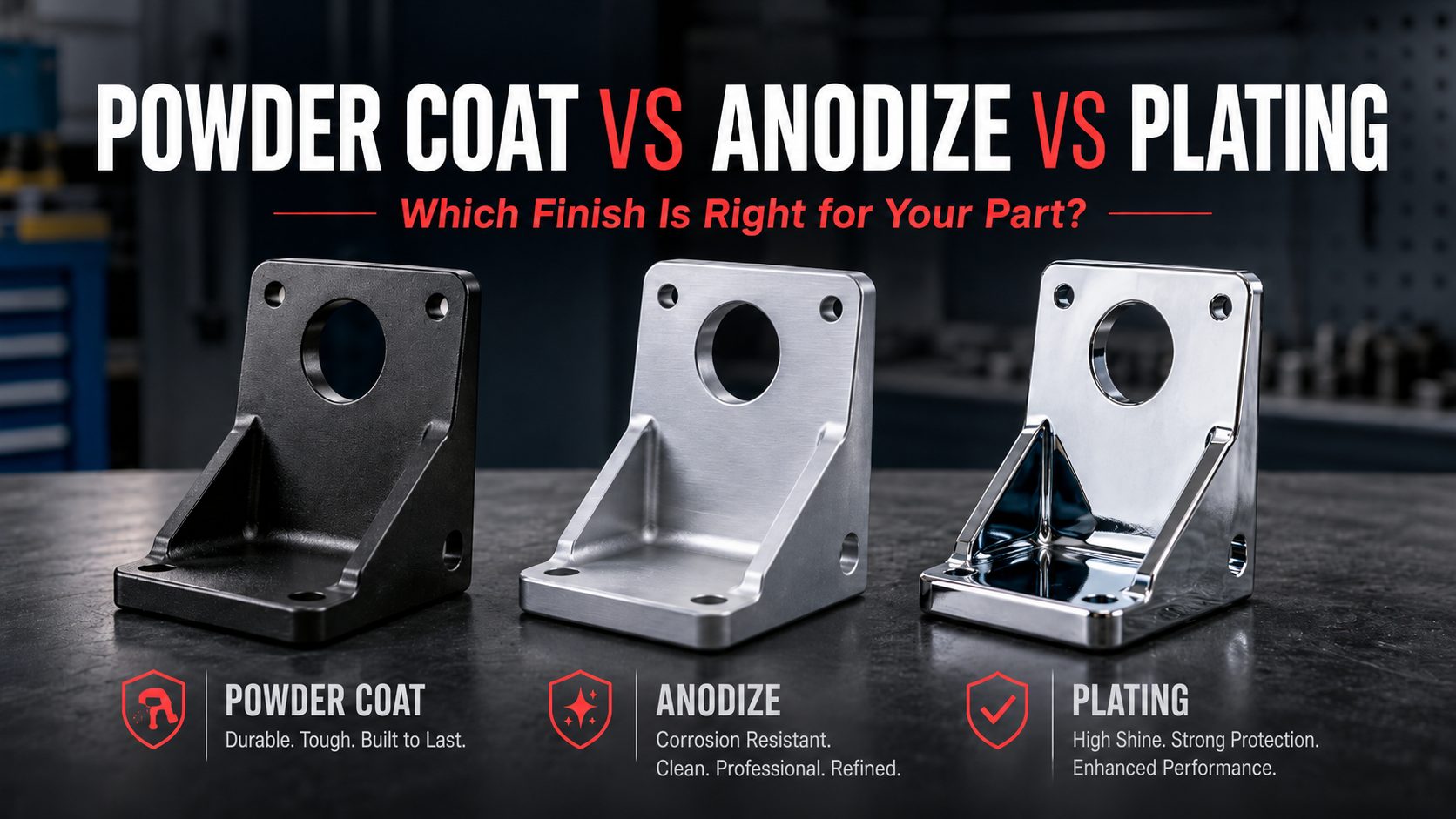
The right finish depends on the base material, the part’s environment, and whether appearance, conductivity, or corrosion resistance matters most.
Finish is a design decision, not an afterthought. The base material, cosmetic requirements, and masked areas all influence how a part should be built — sometimes from the very first cut. Specifying it early avoids reworking parts that were technically in spec but finished wrong.
Powder Coating
Powder coating is a dry finishing process where electrostatically charged powder is applied to the part and then cured under heat to form a hard, durable layer. It’s one of the most versatile and widely used finishes in sheet metal fabrication.
Best for: Enclosures, chassis, brackets, frames, and any part where a durable, attractive, colored finish matters. It works on steel, aluminum, and most metals.
Strengths: Excellent durability and impact resistance, a huge range of colors and textures, good corrosion protection, thick and even coverage, and an environmentally friendly process with no solvents. It’s often the most cost-effective way to get a tough, finished look.
Keep in mind: Powder coat adds measurable thickness, so tight-tolerance features, threaded holes, and mating surfaces usually need to be masked. It’s not ideal where electrical conductivity is required, since the coating is an insulator. Call out masked and grounding areas on the drawing.
Anodizing
Anodizing is an electrochemical process that converts the surface of aluminum into a hard, corrosion-resistant oxide layer. Unlike powder coat or plating, it isn’t a coating added on top — it’s a controlled growth of the aluminum’s own surface, so it won’t chip or peel.
Best for: Aluminum parts that need corrosion and wear resistance, a premium finished appearance, or electrical insulation — common in aerospace, electronics, medical, and consumer products.
Strengths: Extremely hard and wear-resistant, excellent corrosion resistance, very thin and dimensionally stable, can be dyed in a range of colors, and provides electrical insulation. Type II gives a durable decorative finish; Type III (hardcoat) gives a much thicker, tougher layer for demanding wear applications.
Keep in mind: Anodizing works on aluminum (and a few other metals), not on steel. Because it’s an insulator, areas needing electrical contact or grounding must be masked. Color consistency across lots and alloys takes care, so cosmetic parts should call out the requirement clearly.
Plating
Plating deposits a thin layer of metal — such as zinc, nickel, tin, or chrome — onto the surface of the part, usually through an electroplating or electroless process. The right plating adds corrosion resistance, conductivity, solderability, wear resistance, or appearance, depending on the metal used.
Best for: Parts needing corrosion protection while preserving conductivity, hardware, electrical contacts, connectors, and components that must solder or ground reliably.
Strengths: Maintains electrical conductivity (unlike powder coat and anodize), very thin buildup, and highly tunable — zinc for economical corrosion protection, nickel for wear and corrosion, tin for solderability, chrome for hardness and appearance. Works on steel and many other metals.
Keep in mind: Different plating types serve very different purposes, so the specification needs to match the function — a solderability requirement and a corrosion requirement may call for different platings. Some processes carry environmental and regulatory considerations. Spelling out the plating type, thickness, and any spec (such as a military or ASTM standard) avoids ambiguity.
Quick Comparison
• Need a tough, colored, cost-effective finish on steel or aluminum? Powder coat.
• Need a hard, corrosion-resistant, dimensionally stable finish on aluminum? Anodize.
• Need corrosion protection while keeping conductivity or solderability? Plating.
• Need electrical insulation? Powder coat or anodize.
• Need electrical contact or grounding? Plating — or mask those areas on a coated part.
Not Sure Which Finish Your Part Needs?
Finish selection depends on your material, environment, tolerances, and how the part functions. Send MJM your drawings and our team will help you choose the right finish — and flag any masking, tolerance, or material considerations before production. As a single-source shop, we manage fabrication and finishing together, so your parts arrive finished, inspected, and ready to use. Email sales@mjmmfg.com or call (305) 620-2020.
Sheet Metal Finishing — FAQ
What’s the difference between powder coating, anodizing, and plating?
Powder coating applies a durable colored layer on top of the metal and works on most materials. Anodizing converts the surface of aluminum into a hard oxide layer that won’t chip. Plating deposits a thin metal layer (zinc, nickel, tin, chrome) that adds corrosion resistance while keeping conductivity. Each suits different materials and requirements.
Which finish is best for aluminum?
It depends on the goal. Anodizing is ideal when you need a hard, corrosion-resistant, dimensionally stable finish that won’t chip. Powder coating is better when you need a specific color or a thicker, impact-resistant layer. Plating is used when conductivity must be preserved. Many aluminum parts use anodizing for its durability and clean appearance.
Can you powder coat or anodize a part that needs electrical grounding?
Yes, but the grounding or contact areas must be masked, since both powder coat and anodize are electrical insulators. Call out the masked areas on the drawing. If conductivity is needed across the whole part, plating is usually the better choice.
Does the finish affect part tolerances?
Yes. Powder coating adds measurable thickness, so threaded holes, mating surfaces, and tight-tolerance features often need masking. Anodizing is very thin and dimensionally stable. Plating buildup is thin but should still be accounted for on precision features. Specifying the finish early lets these be planned into the design.
When should I decide on a finish?
As early as possible — ideally during design. Finish affects material choice, tolerances, masking, and sometimes how a part is cut and handled from the start. Deciding early prevents rework and keeps cost and lead time down. Sharing your requirements up front lets your fabricator build the part correctly the first time.
Powder Coating
Anodizing
Plating
Material Selection
Ready to Work With MJM?
47 years of precision. 80+ employees. 37,000 sq ft. Get a quote within 24–48 hours at sales@mjmmfg.com.
MJM Manufacturing, Inc. | AS9100 Certified | ISO 9001 Certified | ITAR Registered | DBE Certified | AWS D17.1 Aerospace Welding | Lloyd’s Register LR 33932 | 5205 NW 161 Street, Miami Gardens, FL 33014 | (305) 620-2020