Laser Cutting · August 2026
Five Amada Lasers: What We Cut, How Thick, and How Fast
A laser is the most expensive machine in a sheet metal shop, and the one customers understand the least. Most quotes just say “laser cut” and leave it there.
This is what is actually in our laser department — five Amada systems, four fiber and one CO2, all with 5 foot by 10 foot beds — what each one is good at, every material and thickness we run, and why the assist gas coming out of the nozzle matters as much as the machine behind it.
If you buy laser cut parts, this is the information you need to specify them correctly and to know whether a shop can actually make what you drew.
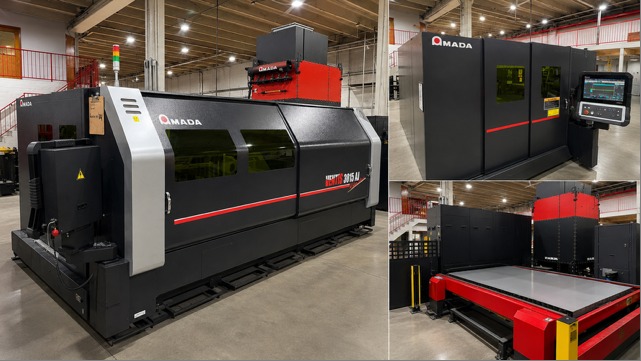
Amada Ventis 3015 AJ with Locus Beam Control — one of five laser systems on our floor, all running 5′ × 10′ beds.
Capacity
Why Five Machines Instead of One Big One
A shop with one laser has one answer to every question, and that answer is “after the job in front of you.”
Five machines changes the scheduling math completely. A production run occupies one table while a five-piece prototype goes on another. A rush order does not sit behind somebody else’s thousand-part release. A machine down for maintenance costs us capacity, not your delivery date. And when a job needs a specific beam behavior — thick mild steel with oxygen, or thin stainless that has to come off clean enough to weld without secondary work — it goes to the machine built for that instead of the machine that happens to be free.
This is the part that does not show up on a quote. You see a price and a date. What produced that date was whether the shop had a table free when your file arrived.
All five of our systems run a 5 foot by 10 foot bed, so a full standard sheet nests on any of them. Nothing about your part has to change based on which machine it lands on.
The Machines
Four Fiber and One CO2, and Why We Keep Both
Amada Ventis 3015 AJ — 4kW with Locus Beam Control
Conventional fiber lasers fire a fixed round spot, and the problem with a fixed spot is that energy density falls off as material gets thicker — which is why edge quality degrades and speeds drop on heavier plate. Locus Beam Control solves that differently. Instead of one static beam shape, the machine steers the beam through programmed locus patterns inside the kerf, matching the pattern to the material and thickness in front of it. Amada’s stated results are virtually dross-free cutting and near burr-free edges on stainless and aluminum. In practice it means parts that come off the table ready for the next operation instead of ready for a deburring bench.
Three Amada Ensis 3015 AJ — 3kW Variable Beam
The Ensis resonator automatically varies the diameter of the beam itself, optimizing the laser mode and beam parameter product for the thickness being cut. On most fiber lasers, moving between thin gauge and heavy plate means changing lenses and nozzles — setup time, and a reason for a shop to batch your job until the machine is configured the way your part needs. The Ensis machines change that in software, which is why we can run a 16 gauge job and a quarter inch job back to back without a changeover between them.
Amada LC 2415 A III — CO2
Fiber has replaced CO2 for most sheet metal work — it is faster on thin material, far more efficient to run, and it handles metals CO2 struggles with. But CO2 has not stopped being useful. Its longer wavelength behaves differently in the cut, and there are specific materials and finishes where it remains the right tool. Keeping it in the building means we are not forced to make a fiber laser do a job it is not suited to.
Materials
Everything We Cut, and How Thick
Maximum thickness and optimal thickness are not the same number. We can cut to the limits below. Whether you should design to them is a separate conversation, and one worth having before you release the drawing.
Cut tolerance across all materials is ±0.005″. If you need tighter than that on a laser cut feature, tell us before you quote it — it usually means a secondary operation, and it is far cheaper to plan for than to discover.
The Hard Ones
Copper, Brass, and Why Most Shops Say No
If you have ever sent a copper or brass part out for quote and gotten silence back, this is why.
Copper and brass are highly reflective. A CO2 laser operates at a wavelength these metals reflect rather than absorb, and that reflected energy travels back up the beam path toward the resonator. It is slow, it is unreliable, and it can damage the machine. For a long time the standard answer from most job shops was simply that they did not cut copper.
Fiber lasers operate at roughly one tenth that wavelength, and copper absorbs it far more readily. The reflection problem largely goes away. That is the single biggest reason fiber displaced CO2 for anyone working in nonferrous metals.
We cut copper and brass to 0.375″ and we run beryllium copper as well — a material that shows up in electrical contacts, springs, and connector hardware, and one that a lot of shops will not quote at all. If your part is in a conductive alloy and you have been struggling to find someone to make it, that is a conversation worth having.
Assist Gas
The Gas Matters as Much as the Laser
The beam melts the material. The assist gas blowing through the nozzle is what clears the molten metal out of the kerf — and which gas you use changes what the finished edge is.
Oxygen reacts with steel and adds its own heat to the cut. It is faster and it lets you cut thicker. It also leaves an oxide layer on the cut edge. That oxide has to come off before the part can be painted, powder coated, or welded — which is a secondary operation nobody put on the drawing.
Nitrogen is inert. It does not react, it does not add heat, and it leaves a clean, bright, oxide-free edge that can be welded or finished exactly as it comes off the table. It is slower and it consumes far more gas, which is precisely why some shops ration it.
We generate our own nitrogen on site — three CSD 75T Sigma systems feeding the laser department. No cylinder deliveries to run out of, no purity variation between suppliers, and no economic reason to talk you out of nitrogen when your part needs it.
If your stainless or aluminum parts get welded or finished downstream, this is not a detail — it is the difference between a part that moves straight to the next operation and a part that goes to a bench first.
Send Us a File
What Makes a File Ready to Cut
The fastest quotes and the fastest parts come from clean files. Most of the delay between “I sent it” and “you quoted it” is somebody in our building fixing geometry.
Send a DXF of the flat, or a STEP file of the formed part. If you send STEP, we develop the flat pattern ourselves using our own bend deduction — which is the right way to do it, because your flat and our tooling may not agree. If you send a DXF you developed elsewhere, tell us, and tell us what bend allowance it assumes.
Closed contours, no duplicates. Open profiles and doubled lines are the two most common problems in a DXF. Doubled geometry can cut the same path twice, which is slow at best and damages the part at worst.
State the material, thickness, and grade. “Aluminum” is not a material. 5052-H32 and 6061-T6 cut similarly and form nothing alike, and if the part gets bent later, the wrong assumption costs you a run.
Say what happens to the part next. Welded, powder coated, anodized, or shipped as-cut. That single sentence determines the assist gas, and therefore the edge you get.
A file that arrives with those four things gets quoted faster and cut sooner. See our breakdown of what drives part cost for how nesting and quantity affect the number that comes back.
When You Need It Sooner
Expedited Laser Cutting
Cut-only work is the fastest thing we do. There is no forming setup, no weld fixture, no hardware, and no finish schedule to coordinate. A clean file, material on the floor, and an open table is all it takes.
That is where five machines pay off for you rather than for us. We can schedule expedited laser cutting because there is usually a table available, and because our quotes come back in 24 to 48 hours instead of next week.
Send the file and ask. We will tell you the actual date we can have parts on your dock — not a standard lead time, the real one for your job, based on what is on the floor that week and whether we stock your material.
And if you are in South Florida, there is no freight in that number at all. We are in Miami Gardens. Parts get picked up or delivered, same week, with nobody’s tracking number involved.
And Then
The Laser Is the First Operation, Not the Only One
Plenty of customers send us cut-only work and that is a perfectly good relationship. But it is worth knowing what the same part could come back as, because the blank leaving our laser is thirty feet from everything else.
Nine Amada forming machines, including a 240 ton press brake with a 14 foot bed. Nine IPG fiber laser welders plus certified TIG and MIG. Hardware insertion, tapping, machining, deburring, laser part marking. Powder coat, anodize, and plating through our finishing partners. Five independent measurement systems and an AS9100 and ISO 9001 quality system behind all of it.
Which means a part you currently cut here, form somewhere else, and finish at a third place can be one purchase order, one lead time, and one company accountable for the result.
No pressure to consolidate. Just know the option exists the next time coordinating three vendors costs you a delivery date. See the full equipment list or how we verify parts before they ship.
Send One File
Send Us One Part You Already Buy
You do not have to move a program to find out what we would charge and when we could deliver. Send one laser cut part you are already buying — a DXF or a STEP file, no drawing required — and we will quote it as a benchmark. Back to you in 24 to 48 hours.
MJM Manufacturing, Inc. · 5205 NW 161 Street, Miami Gardens, FL 33014 · (305) 620-2020 · sales@mjmmfg.com
Five Amada Lasers · 5′ × 10′ Beds · Onsite Nitrogen · AS9100 & ISO 9001 Certified