Welding · September 2026
Fiber Laser Welding: The Welds You Don’t Have to Grind
Anyone who has welded thin sheet metal knows the two problems. The heat pulls the part out of shape, and the bead has to be ground and blended before anyone will accept it.
Both of those are costs. The distortion costs you straightening, or a scrapped assembly. The grinding costs you labor on every single piece — and on a cosmetic part it can take longer than the welding did.
We run nine handheld fiber laser welders, and the reason is those two problems. This is what the technology actually does, what it can weld and how thick, where it beats TIG and MIG, and where it does not.
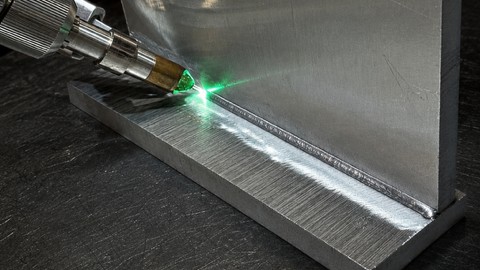
A fillet weld going down in aluminum. Note the bead behind the torch — that is as-welded, not ground.
The Equipment
Nine Handheld Systems, Three With Dual Wire Feed
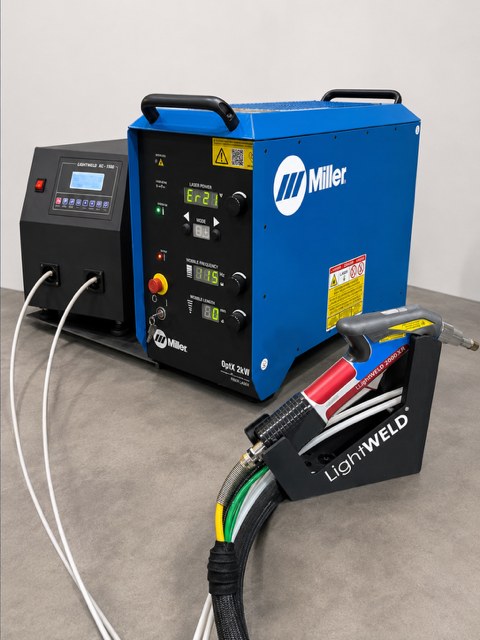
Our welding department runs nine 2kW-class handheld fiber laser welding systems — a mix of LightWELD 1500 and LightWELD 2000 units. Three of them are now fitted with Serra LightWIRE double wire feeders.
Nine machines matters for the same reason five lasers matters on the cutting side. Weld work does not queue behind one cell. A production assembly and a one-off repair can run at the same time, and a rush job does not wait for somebody else’s batch to clear.
These are handheld systems, which matters more than it sounds. The torch goes to the part instead of the part going into a fixture — so a large welded enclosure or a formed frame gets welded where it sits, without building tooling first.
Every one of these systems also runs a laser cleaning mode, which removes soot, oxidation, and discoloration from the seam without abrasives or chemicals.
Speed
Up to Four Times Faster Than TIG
IPG publishes laser welding at up to 4× the speed of TIG, and up to 300% faster welding overall. On a long straight seam in thin material, that is roughly what we see.
The reason is straightforward. TIG is slow because it puts heat into a puddle and waits for it to fuse, and the operator is managing torch, filler, and pedal simultaneously. A focused laser reaches fusion temperature almost instantly in a very small area, so travel speed is limited by how fast the operator can move rather than by how fast the metal will accept heat.
Where it does not win: laser welding is not a replacement for arc welding on heavy structural material, and it is far less forgiving of a bad joint fit than MIG. It is a tool that is dramatically better at a specific set of jobs, not a universal upgrade. We still run certified TIG and MIG for the work that needs them.
The speed is real, but it is not the biggest saving. The biggest saving is what happens after the weld.
Heat
Your Parts Come Back Flat
Distortion is not a welding problem. It is a heat problem. Metal expands where you heat it, the surrounding cold material resists, and when it cools the part is no longer the shape you drew.
On thin gauge sheet, that shows up as a warped panel, a door that will not close square, an enclosure that has to be straightened by hand before it can be assembled. Every one of those is time nobody quoted.
Laser welding attacks the cause. The energy is concentrated into a very small spot and the travel speed is high, so the total heat put into the part is a fraction of what an arc process delivers. IPG describes it as highly focused energy that greatly minimizes heat input and distortion and keeps warpage and burn-through from happening. The heat affected zone is narrow enough that on many parts you can put a hand on the material inches from the weld.
What that means practically: less straightening, less scrap on thin material, no burn-through on gauges where TIG is a nervous operation, and dimensional stability on assemblies where a weld used to pull a critical dimension out of tolerance.
It also means welded assemblies hold the tolerances we formed into them — which is the whole point of verifying parts after welding, not just before.
The Real Saving
The Weld You Don’t Have to Grind
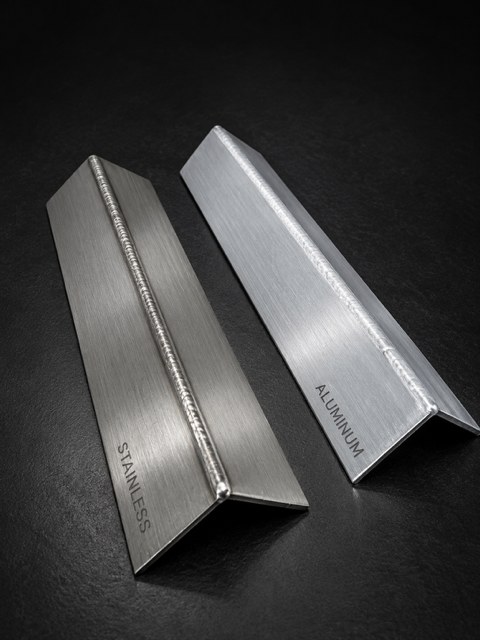
These two coupons — one stainless, one aluminum — are as-welded. Nothing has been ground, blended, or polished.
That is the part of this technology that shows up on your invoice. Grinding and blending a weld is pure labor, it happens on every piece, and on a cosmetic assembly it routinely takes longer than the welding did. IPG’s own language is that these welds require little to no time-consuming post-processing — you can skip the grinding.
In our experience that holds for a large share of the work. Many customers look at the as-welded bead and decide they do not need finishing at all, which removes an operation from the routing and takes real cost out of the part.
We will tell you honestly when it does not apply. A mirror-polished architectural piece or a spec that calls for a specific ground profile still needs finishing. But the default assumption that every weld gets ground is worth re-examining — bring us a part you currently pay to have blended and let us weld one.
See what actually drives the price of a sheet metal part for why weld finishing is one of the largest hidden costs on a fabricated assembly.
Materials
What We Weld, and How Thick
Our nine systems are a mix of two capability classes. Published maximums for each:
Those are single-pass maximums. In practice most of what comes through our welding department is well under them — sheet metal enclosures, chassis, racks, brackets, and frames in the 16 gauge to 0.125″ range, where the speed and heat advantages are largest.
New Capability
Dual Wire Feed Solves the Fit-Up Problem
The honest limitation of laser welding has always been joint fit. A focused beam does exactly what you point it at — which is excellent when two edges are tight together, and useless when there is a gap the beam falls straight through.
That is what wire feed fixes, and why we have just added two more Serra LightWIRE double wire feeders, bringing us to three. Dual wire feed runs on aluminum as well as steel and stainless. That matters more than it sounds: aluminum is where fit-up gaps punish you hardest and where adding filler cleanly by hand is most difficult, so it is the material where a second wire earns its keep.
A dual feed clip delivers two wires into the weld pool simultaneously, fed parallel at the nozzle tip with the laser centered between them, and the wobble function welds both wires as they feed. The result is that material goes into the joint roughly twice as fast as single wire.
What That Actually Buys You
Tolerance for imperfect fit-up. Gaps that would have forced a re-fixture or a return to the brake now get filled. Parts that arrive from forming with a little spring or a slightly open joint still weld.
Larger fillets in a single pass. Where a weld specification calls for a bigger fillet width or radius than a single wire can build, dual feed adds the material in one pass instead of requiring overlapping welds. That keeps the operator moving and — critically — puts less total heat into the part, because you are not going over the same joint twice.
Faster build-up. On joints that need volume of filler rather than just fusion, two wires do it in half the passes.
The feeders handle wire up to 0.060″ (1.5 mm) through a twin-groove weld tip, with feed rates from 0.1 to 18 m/min. Steel and stainless run through steel liners; a separate Teflon liner set handles softer wire.
Clean In, Clean Out
We Make Our Own Nitrogen
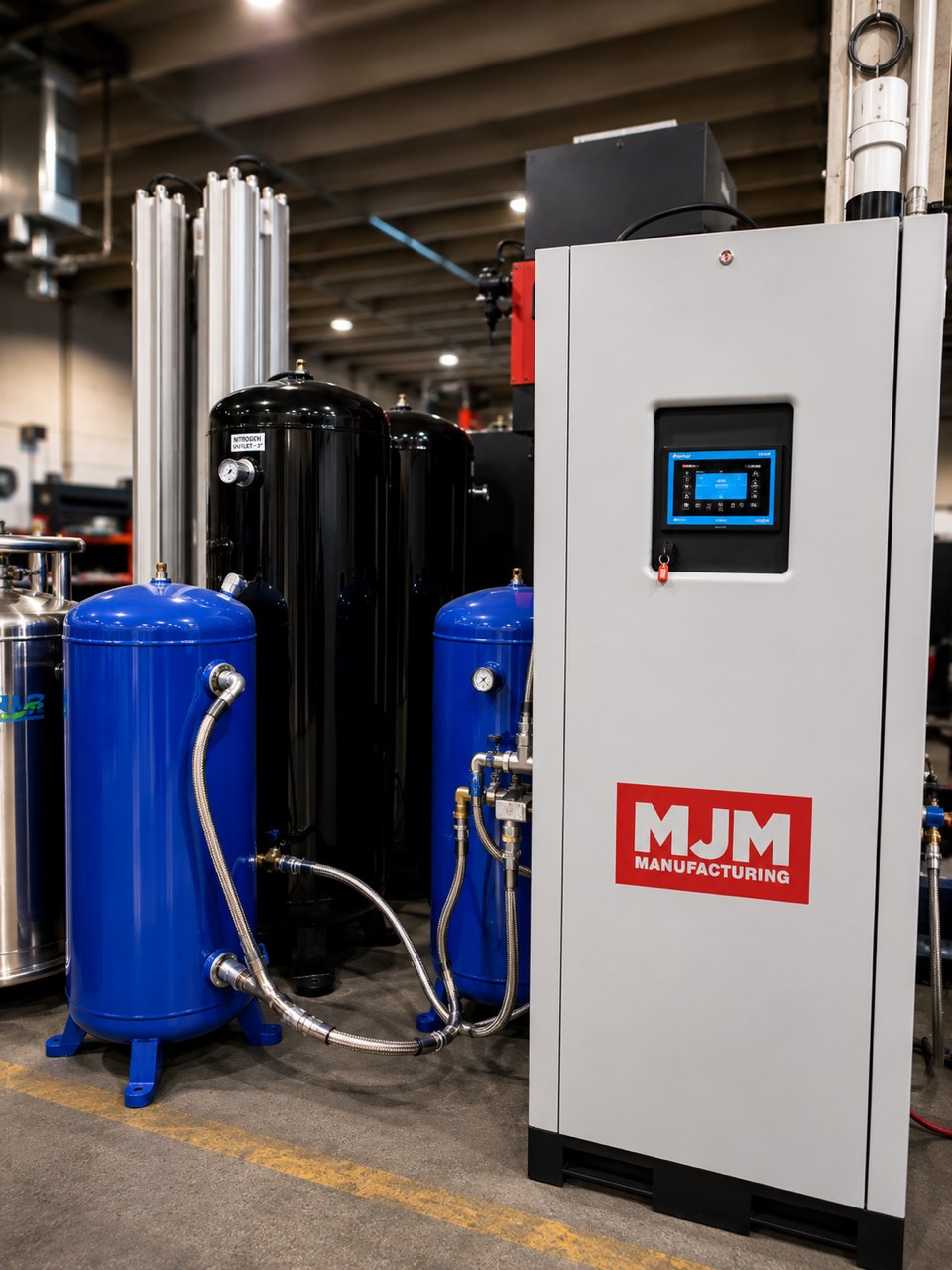
We generate nitrogen on site, at purities from industrial grade up to 99.9999%. Most shops buy gas in cylinders or bulk and pay by the unit, which quietly creates an incentive to use less of it.
On the cutting side that means oxide-free, bright edges on stainless and aluminum. But it matters to welding too, and for a reason most people miss.
A weld is only as clean as the joint it starts from. An oxygen-cut edge carries an oxide layer straight into the weld pool, and that contamination shows up as porosity, discoloration, and inclusions. Parts cut under high-purity nitrogen arrive at the weld cell clean — better weld preparation with less contamination at the joint.
That is a large part of why the beads in the photo above look the way they do. It is not only the laser. It is the fact that the material going under it was clean to begin with.
Shielding gas at the weld itself is matched to the material and the joint. More on the cutting side in why nitrogen purity matters in precision laser cutting.
Qualified
Certified Welding, Documented
New technology is worth very little to a buyer without the qualifications behind it. Our welding department holds:
AWS D9.1M — the sheet metal welding code, the standard most directly applicable to the work we do. AWS D1.1 for structural steel and AWS D1.2 for structural aluminum. And AWS D17.1, the aerospace fusion welding standard, held with Lockheed Martin program approval — one of the most demanding welding qualifications available.
Behind each of those sit qualified Weld Procedure Specifications and Procedure Qualification Records, plus welder performance qualification records. We also hold Lloyd’s Register approval under LR 33932 — independent third-party validation of our welding procedures and welder qualifications, which is a requirement for a lot of marine and defense work.
All of it operates inside our AS9100 and ISO 9001 certified quality system. Weld maps, inspection records, and material certifications ship with the parts when your program requires them.
The full list is on our certifications page, and the rest of the department is on the equipment list — including three Sciaky resistance spot welders from 75 to 200 KVA alongside the laser systems and our certified TIG and MIG stations.
Send Us a Weldment
Send Us a Part You Currently Pay to Grind
If you have a welded assembly that warps, needs straightening, or gets blended by hand on every piece, that is exactly the part we want to see. Send the drawings or a STEP file and we will quote it — and tell you honestly whether laser welding changes anything for your part or not. Back to you in 24 to 48 hours.
MJM Manufacturing, Inc. · 5205 NW 161 Street, Miami Gardens, FL 33014 · (305) 620-2020 · sales@mjmmfg.com
Nine Fiber Laser Welders · AWS D1.1 · D1.2 · D9.1M · D17.1 · Lloyd’s Register LR 33932 · AS9100 & ISO 9001