
Data Center Sheet Metal Fabrication & Manufacturing | MJM Manufacturing
Precision Sheet Metal Fabrication for Data Center & Infrastructure OEMs
MJM Manufacturing provides precision data center fabrication — sheet metal fabrication, machining, welding, powder coating, and OEM manufacturing for server, infrastructure, and high-performance computing applications. We produce server rack enclosures, chassis, cable management, mounting rails, blanking panels, and structural assemblies from prototype through high-volume production. AS9100 and ISO 9001 certified, with the tight tolerances and repeatability that rack-mount and infrastructure hardware demand.
Data center hardware requires precise, repeatable fabrication for rack-unit (U) compatibility, clean airflow management, and consistent fit across high-volume runs — all core strengths of our in-house fabrication process.
Data Center Manufacturing Capabilities
- Custom server and infrastructure enclosures
- Precision CNC laser cutting — 5 Amada fiber lasers, tolerances to ±0.005″
- CNC turret punching — high-volume ventilation patterns and cable cutouts
- CNC forming and bending — 9 Amada forming machines
- Certified TIG and MIG welding
- CNC machining and mechanical assemblies
- Hardware insertion — PEM fasteners, cage nuts, standoffs, mounting hardware
- Powder coating and finishing (turn-key coordinated)
- Automated optical inspection and CMM dimensional verification
- Prototype through high-volume production manufacturing
Data Center Components MJM Produces
- Server rack enclosures and cabinets
- Rack-mount chassis and server housings
- Cable management trays and panels
- Blanking panels and filler panels
- Mounting rails and rack hardware
- Airflow management and containment components
- Power distribution enclosures
- Structural frames and infrastructure assemblies
Materials We Fabricate for Data Centers
MJM Manufacturing works with the full range of data center and infrastructure materials:
- Cold rolled steel (CRS) — standard rack and enclosure material, powder coated
- Aluminum (5052, 6061) — lightweight panels and chassis
- Stainless steel (304, 316) — corrosion-resistant components
- Galvanized steel — structural members and infrastructure
- Copper — grounding, busbar, and electrical components
Infrastructure & Server Fabrication
MJM Manufacturing supports data center and infrastructure manufacturers with precision fabricated components, enclosures, structural assemblies, and high-volume production designed for demanding computing environments. Our automated inspection — Amada Fabri-Vision and Keyence measurement systems — ensures dimensional consistency across large production runs. See our full equipment and inspection capabilities.
Prototype to Production Manufacturing
MJM supports data center and infrastructure customers from prototype development through full-scale production, with DFM engineering review included at no charge. As a single-source OEM manufacturing partner, MJM scales with your program from first article to high-volume production without changing vendors.
Why Data Center OEMs Choose MJM
- Tight-tolerance, repeatable fabrication — consistent rack-unit fit across high-volume runs
- High-volume capability — CNC turret punching and laser cutting for production quantities
- AS9100 & ISO 9001 certified — audited quality systems
- Full in-house process — cutting, forming, welding, hardware, finishing, assembly
- Automated inspection — dimensional verification and documentation
- 47 years & 44,000 sq ft Miami Gardens facility — proven precision fabrication partner
Certifications & Compliance
MJM Manufacturing holds 17 independent certifications including AS9100, ISO 9001, ITAR registration, DBE certification, MIL-I-45208A, SAM.gov registration, and CAGE Code 0YLX1.
Frequently Asked Questions — Data Center Fabrication
Does MJM Manufacturing fabricate server and infrastructure components?
Yes. MJM supports fabrication and manufacturing for data center, server, and infrastructure applications — including rack enclosures, chassis, cable management, blanking panels, and mounting rails.
Can MJM produce rack-mount enclosures to standard U sizes?
Yes. MJM fabricates rack-mount chassis and enclosures to standard rack-unit (U) dimensions with the tight tolerances required for rack compatibility.
What materials does MJM use for data center hardware?
We work with cold rolled steel, aluminum (5052, 6061), stainless steel, galvanized steel, and copper for data center and infrastructure fabrication.
Does MJM Manufacturing provide powder coating and finishing?
Yes. We provide powder coating, finishing, and assembly services for infrastructure and industrial manufacturing projects.
Can MJM Manufacturing support production manufacturing runs?
Yes. Our team supports low-volume through high-volume production manufacturing.
How do I get a quote for a data center fabrication project?
Email your drawings and specifications to sales@mjmmfg.com with material, gauge, quantity, and requirements, or call (305) 620-2020. Our engineering team responds within 24 to 48 hours.
Data Center Fabrication Case Study
See how MJM delivered a precision data center fabrication program: read the data center case study.
Contact MJM Manufacturing to discuss your data center fabrication project or request a quote at sales@mjmmfg.com.
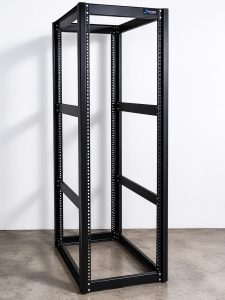
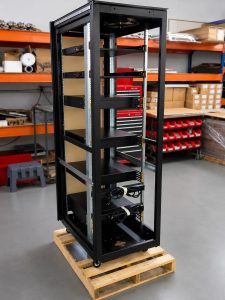
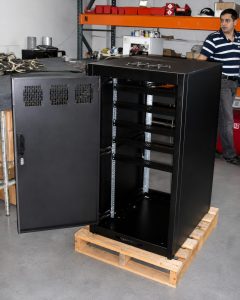
Building to EIA-310
Almost every rack-mount product on the market answers to one document: EIA-310, the standard that defines the 19-inch rack. Get it right and your hardware drops into any cabinet in any facility. Get it wrong by twenty thousandths and it binds on the rails at the customer site — which is a field problem, not a shop problem, and far more expensive.
These are the numbers we build to. They are not negotiable, and they are the first thing our DFM review checks against your print.
| Dimension | Value | Why It Matters |
|---|---|---|
| Rack unit (1U) | 1.750 in (44.45 mm) | Every panel height is an exact multiple. Fractional-U designs strand space. |
| Panel width | 19.000 in (482.6 mm) | Flange-to-flange across the front face. |
| Mounting hole spacing | 0.625 / 0.625 / 0.500 in | The repeating pattern within each U. The 0.500 in gap marks the U boundary. |
| Rail hole centers | 18.312 in (465.1 mm) | Left-to-right centerline distance between mounting rails. |
| Square hole size | 0.375 in (9.5 mm) | Cage nut standard. Punch tooling is dedicated, not improvised. |
| Practical panel height | (1.750 × U) − 0.031 in | The clearance that keeps adjacent panels from stacking tight. |
That last row is where most designs get into trouble. A 1U panel drawn at a full 1.750 inches will fit alone and jam in a populated rack. We flag it before cutting, not after.
Perforation and Open Area
Rack density has climbed faster than most enclosure designs have kept up with. A cabinet that cooled a 3 kW load fifteen years ago is now being asked to pass air for five to ten times that. The front and rear doors are where that fight is won or lost, and the variable is open area — the percentage of the door face that is actually hole.
Modern high-density cabinets are commonly specified at 60 percent open area or better. Getting there is a tooling and structural problem, not a drawing problem. Hex patterns generally yield more open area than round patterns at the same pitch and hold up better structurally, because the remaining material forms continuous ligaments instead of isolated islands. Round perforation is easier on tooling and cheaper at low volume.
The tradeoff nobody mentions until it is too late: every point of open area you add takes stiffness out of the panel. Past roughly 60 percent on a full-height door, we will usually recommend a formed return flange or a bonded stiffener rather than heavier gauge — it holds the panel flat without adding the weight that makes a door sag on its hinges over a few hundred open-close cycles.
We punch ventilation patterns on CNC turret equipment rather than lasering them. On a full door with several thousand holes, punching is faster by an order of magnitude, the hole quality is consistent across the whole panel, and there is no heat input to pull the sheet out of flat.
Tolerance Stack-Up in Tall Assemblies
A 42U frame is roughly six feet of stacked bends. If each forming operation is off by five thousandths and the errors run the same direction, the mounting holes at the top of the frame land a quarter inch from where the print says they should. Every individual bend passes inspection. The assembly still does not work.
This is the single most common failure mode in rack fabrication, and it is why we treat tall assemblies differently from flat parts. Bend deduction is calculated per material, per gauge, per tool — not pulled from a generic table — and offline programming means the same tooling and the same sequence run on every part in every batch, including the batch you order eighteen months from now.
Verification is dimensional, not visual. Amada Fabri-Vision optical inspection checks flat-pattern geometry before forming, and CMM measurement confirms hole position on formed assemblies against the model. On production runs we document first-article dimensions and sample through the run, so a drift shows up in the data before it shows up in your receiving inspection.
Grounding, Bonding, and Paint Masking
Powder coat is an excellent finish and an excellent insulator. That second property is the one that causes problems, because a bonded ground path through a painted joint is not a ground path at all. This shows up late — usually at EMC testing, with tooling already committed.
The fix is decided at the drawing stage. Ground stud locations get masked before coating so bare metal meets bare metal at the joint. Thread-forming hardware can cut through coating to establish continuity where masking is impractical. Conductive gaskets handle door and panel seams where a continuous bond is required around an opening rather than at a point.
None of this is expensive if it is planned. All of it is expensive if it is discovered. Send us the print with the ground paths identified and we will build the masking into the routing from the first article forward.